Dental Radiographic DQA vs QA Testing: What’s the Difference and Why It Matters


When it comes to dental imaging compliance under Safety Code 30, “QA” and “DQA” are often used interchangeably but they’re not the same. Understanding the distinction helps clinics stay compliant, reduce repeat exposures, and maintain consistent diagnostic quality.
1. What QA (Quality Assurance) Testing Means in General
Quality Assurance (QA) refers to the broad set of procedures used to verify that dental X-ray systems perform safely and produce acceptable diagnostic images.
According to Safety Code 30, QA includes:
- Routine constancy checks on all intraoral, panoramic, and CBCT units
- Image-quality evaluation (density, contrast, resolution, noise)
- Radiation output consistency testing
- Documentation of test results and corrective actions
In short, QA testing ensures that the entire imaging system, from the X-ray generator to the display monitor, is functioning properly and within tolerance.
2. What DQA (Digital Quality Assurance) Adds
Digital Quality Assurance (DQA) is a focused subset of QA that deals specifically with digital radiographic systems: the detectors, sensors, software, and digital displays that replaced film.
While film-based QA relied on visual step-wedge comparisons, DQA introduces quantitative, software-based image evaluation. It measures digital parameters such as:
- Pixel value uniformity and signal-to-noise ratio
- Spatial and contrast resolution
- Digital density range and image sharpness
- System stability across time (baseline drift)
DQA also extends QA to data handling: image acquisition, communication, and display systems which are all listed in Section B.3.2 of Safety Code 30.
3. Why the Difference Matters
The difference between traditional QA testing and DQA comes down to how each method collects, measures, and records information.
- Method: QA testing is often manual or visual, relying on the operator’s judgment. DQA uses automated, algorithm-based analysis that removes human subjectivity.
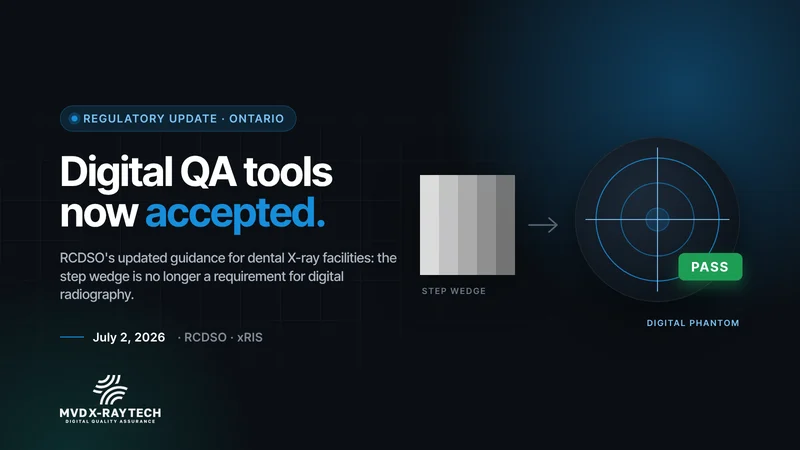
- Tools: Traditional QA uses step wedges or visual comparison charts. DQA uses digital phantoms and software to evaluate image quality directly.
- Data Type: QA results are qualitative - you’re deciding whether an image “looks right.” DQA produces quantitative, numeric values that can be tracked over time.
- Scope: QA applies broadly to both film and digital systems. DQA focuses only on digital radiography - detectors, sensors, and display systems.
- Documentation: Manual QA depends on written logs or spreadsheets. DQA automatically records results to cloud-based or local databases, making compliance tracking effortless.
Clinics that still rely only on manual QA are missing the data-driven verification now expected for digital imaging systems.
4. How Phantom XY Bridges the Two
Phantom XY by MVD X-Ray Technologies performs both QA and DQA functions in one step.
- It provides the daily constancy check required by Safety Code 30.
- It analyzes digital image metrics automatically and produces a quantitative report.
- Results are stored in the cloud for audit-ready traceability.
By combining QA testing with true digital analysis, Phantom XY eliminates subjective judgment and ensures consistent image quality across all radiographic units.
5. The Bottom Line
- QA ensures your imaging system functions correctly.
- DQA proves it does, with measurable, repeatable data.
As clinics transition fully to digital radiography, DQA isn’t just an upgrade; it’s the modern standard for compliance and patient safety.