
AQ et AQN en radiographie dentaire : quelle est la différence et pourquoi c'est important


En matière de conformité de l'imagerie dentaire selon le Code de sécurité 30, les termes « AQ » et « AQN » sont souvent utilisés de façon interchangeable, mais ils ne désignent pas la même chose. Comprendre cette distinction aide les cliniques à demeurer conformes, à réduire les reprises et à maintenir une qualité diagnostique constante.
1. Ce que signifie l'AQ (assurance qualité) en général
L'assurance qualité (AQ) désigne le large éventail de procédures utilisées pour vérifier que les systèmes de radiographie dentaire fonctionnent de façon sécuritaire et produisent des images diagnostiques acceptables.
Selon le Code de sécurité 30, l'AQ comprend :
- Des vérifications de constance de routine sur toutes les unités intraorales, panoramiques et de tomographie volumique à faisceau conique (TVFC)
- L'évaluation de la qualité de l'image (densité, contraste, résolution, bruit)
- Des tests de constance du rendement de radiation
- La documentation des résultats de tests et des mesures correctives
En résumé, les tests d'AQ garantissent que l'ensemble du système d'imagerie, du générateur de rayons X jusqu'au moniteur d'affichage, fonctionne correctement et dans les tolérances prévues.
2. Ce que l'AQN (assurance qualité numérique) ajoute
L'assurance qualité numérique (AQN) est un sous-ensemble ciblé de l'AQ qui porte spécifiquement sur les systèmes radiographiques numériques : les détecteurs, les capteurs, les logiciels et les affichages numériques qui ont remplacé la pellicule.
Alors que l'AQ argentique reposait sur des comparaisons visuelles avec un coin sensitométrique, l'AQN introduit une évaluation quantitative de l'image fondée sur un logiciel. Elle mesure des paramètres numériques tels que :
- L'uniformité de la valeur des pixels et le rapport signal sur bruit
- La résolution spatiale et de contraste
- La plage de densité numérique et la netteté de l'image
- La stabilité du système dans le temps (dérive par rapport à la valeur de référence)
L'AQN étend également l'AQ à la gestion des données : les essais de contrôle de la qualité sur les systèmes d'acquisition, de stockage, de communication et de visualisation de l'image, tous mentionnés à la section B.3.2 du Code de sécurité 30.
3. Pourquoi la différence est importante
La différence entre les tests d'AQ traditionnels et l'AQN tient à la façon dont chaque méthode recueille, mesure et consigne l'information.
- Méthode : les tests d'AQ sont souvent manuels ou visuels, reposant sur le jugement de l'opérateur. L'AQN utilise une analyse automatisée, fondée sur des algorithmes, qui élimine la subjectivité humaine.
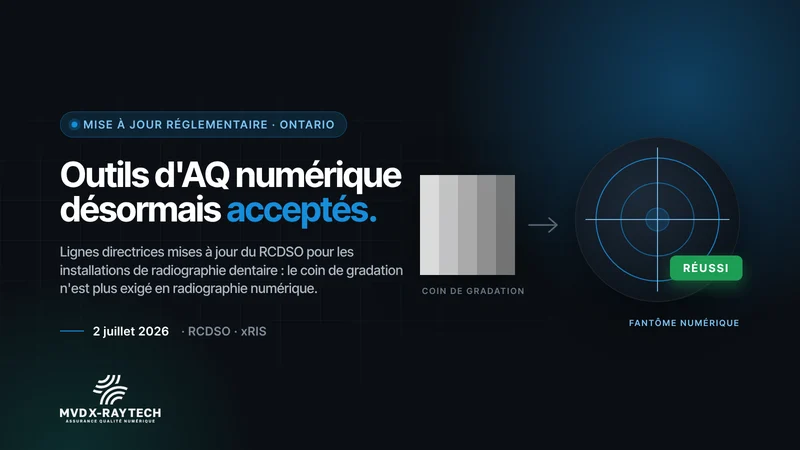
- Outils : l'AQ traditionnelle utilise des coins sensitométriques ou des tableaux de comparaison visuelle. L'AQN utilise des fantômes numériques et un logiciel pour évaluer directement la qualité de l'image.
- Type de données : les résultats d'AQ sont qualitatifs - on détermine si une image « semble correcte ». L'AQN produit des valeurs numériques quantitatives qui peuvent être suivies dans le temps.
- Portée : l'AQ s'applique largement aux systèmes argentiques et numériques. L'AQN se concentre uniquement sur la radiographie numérique - détecteurs, capteurs et systèmes d'affichage.
- Documentation : l'AQ manuelle dépend de registres écrits ou de feuilles de calcul. L'AQN consigne automatiquement les résultats dans des bases de données infonuagiques ou locales, ce qui simplifie le suivi de la conformité.
Les cliniques qui dépendent encore uniquement de l'AQ manuelle passent à côté de la vérification fondée sur les données désormais attendue pour les systèmes d'imagerie numérique.
4. Comment Phantom XY réunit les deux
Phantom XY, de MVD X-Ray Technologies, remplit à la fois les fonctions d'AQ et d'AQN en une seule étape.
- Il assure la vérification de constance quotidienne exigée par le Code de sécurité 30.
- Il analyse automatiquement les mesures d'image numérique et produit un rapport quantitatif.
- Les résultats sont stockés dans le nuage pour une traçabilité prête aux audits.
En combinant les tests d'AQ à une véritable analyse numérique, Phantom XY élimine le jugement subjectif et garantit une qualité d'image constante sur l'ensemble des unités radiographiques.
5. En résumé
- L'AQ garantit que votre système d'imagerie fonctionne correctement.
- L'AQN le prouve, avec des données mesurables et reproductibles.
À mesure que les cliniques effectuent la transition complète vers la radiographie numérique, l'AQN n'est pas simplement une mise à niveau ; elle constitue la norme moderne de conformité et de sécurité des patients.