
Daily X-Ray QA: Ensuring Patient Safety and Compliance

Why Daily QA Matters in Dentistry
Radiographic imaging is one of the most critical tools in modern dental care. Every day, dental clinics rely on digital X-ray systems to diagnose and treat patients accurately. But how often do we verify that these systems are actually performing as intended?
That’s the goal of Daily Quality Assurance (DQA) testing - to ensure your X-ray device consistently produces safe, high-quality diagnostic images. These tests protect both patients and staff from unnecessary radiation exposure while maintaining compliance with Health Canada’s Safety Code 30 guidelines.
What Safety Code 30 (2022) Requires
Health Canada’s Safety Code 30: Radiation Protection in Dentistry sets the national standard for radiographic safety and quality control in dental facilities. It outlines routine testing requirements for intraoral, panoramic, and CBCT systems, including:
- Daily consistency tests on image quality
- Weekly monitoring of exposure reproducibility
- Quarterly or annual full performance evaluations
- Documentation and immediate corrective actions for failed tests
In Section B.3.2 (Digital Imaging Systems) of Safety Code 30: Radiation Protection in Dentistry, the code emphasizes that "specific quality control testing must be performed on the image acquisition, storage, communication, and display systems" of all digital X-ray equipment.
The Compliance Problem: Step Wedges Are Outdated
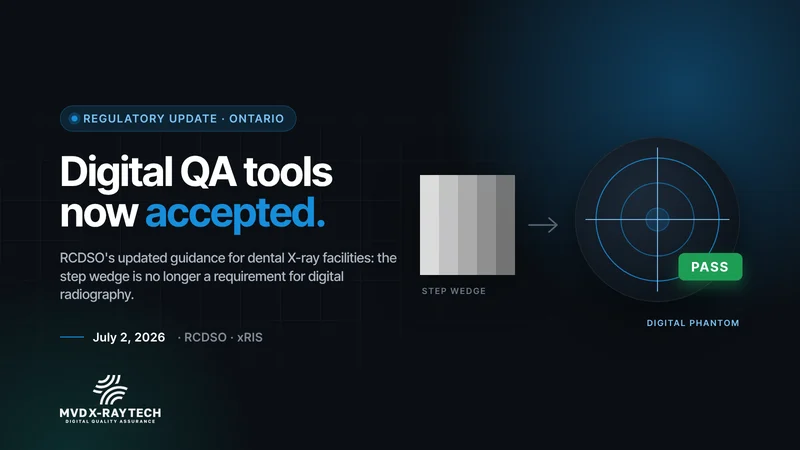
Many clinics still perform their “daily QA” with a step wedge, a tool originally designed for film-based radiography in the 1950s. While step wedges provide a crude visual reference, they cannot accurately assess the performance of a digital X-ray detector or monitor modern imaging metrics.
Digital radiography systems require quantitative testing, not visual approximations. The issue? Most clinics haven't yet caught up with the reality of digital QA - leaving many technically non-compliant even when performing daily tests.
The Shift Toward Digital QA Devices
To truly comply with the intent of Safety Code 30 (ensuring image consistency, patient safety, and radiation optimization) dental clinics must use phantom-based digital QA devices rather than visual tools like step wedges.
A phantom device is a engineered reference object used to test the consistency and accuracy of digital X-ray systems. These patterns allow software to automatically measure contrast, sharpness, density, and uniformity, producing objective numerical data and removing human interpretation from the QA process.
This is where MVD X-Ray Technologies comes in.
Meet the Phantom XY - The First and Only Digital QA Phantom
The Phantom XY for intraoral panoramic and Phantom XY 3D for panoramic devices by MVD X-Ray Technologies is the only fully digital QA phantom on the market designed for dental radiography compliance under Safety Code 30.
Each system is paired with integrated QA software that automatically analyzes every part of the imaging chain - from acquisition and processing to storage, communication, and display. This ensures that clinics can verify image quality and consistency across all digital workflows, not just at the exposure stage.
It’s built to perform daily consistency testing on intraoral and panoramic X-ray devices, giving clinics:
- Automated quantitative QA (no visual estimation)
- Instant pass/fail results based on digital metrics
- Cloud storage and traceability for all test records
- AI-driven image analysis aligned with Health Canada’s safety expectations
With Phantom XY, clinics can demonstrate daily compliance, reduce radiation exposure risk, and maintain audit-ready QA documentation at all times.
Why This Matters Now
Health Canada’s Safety Code 30 establishes the national standards for radiation protection and quality assurance in dental radiography. While the code already mandates daily constancy testing, many clinics still rely on film-era tools that don’t reflect the realities of modern digital imaging.
By transitioning to a digital phantom-based QA workflow, clinics can ensure their testing aligns with current Safety Code 30 expectations, strengthens patient safety, and demonstrates a proactive commitment to compliance and inspection readiness.