Assurance qualité quotidienne pour sécurité et conformité

Pourquoi l'AQ quotidienne compte en dentisterie
L'imagerie radiographique est l'un des outils les plus essentiels des soins dentaires modernes. Chaque jour, les cliniques dentaires comptent sur leurs systèmes de radiographie numérique pour diagnostiquer et traiter les patients avec précision. Mais à quelle fréquence vérifie-t-on réellement que ces systèmes fonctionnent comme prévu ?
C'est l'objectif des tests d'assurance qualité numérique quotidiens (AQN) - garantir que votre appareil de radiographie produit systématiquement des images diagnostiques sûres et de haute qualité. Ces tests protègent à la fois les patients et le personnel contre une exposition inutile aux radiations, tout en maintenant la conformité avec les lignes directrices du Code de sécurité 30 de Santé Canada.
Ce qu'exige le Code de sécurité 30 (2022)
Le Code de sécurité 30 (2022) de Santé Canada, Radioprotection dans l'exercice de la dentisterie, établit la norme nationale de sécurité radiographique et de contrôle de la qualité dans les établissements dentaires. Il précise les exigences de tests de routine pour les systèmes intraoraux, panoramiques et de tomographie volumique à faisceau conique (TVFC), notamment :
- Des tests de constance quotidiens sur la qualité de l'image
- Un suivi hebdomadaire de la reproductibilité de l'exposition
- Des évaluations complètes du rendement trimestrielles ou annuelles
- La documentation et des mesures correctives immédiates en cas d'échec des tests
À la section B.3.2 (systèmes d'imagerie numérique) du Code de sécurité 30 (2022) de Santé Canada, le code précise que « pour ce qui est des systèmes numériques, on doit également effectuer des essais de contrôle de la qualité sur les systèmes d'acquisition, de stockage, de communication et de visualisation de l'image » de tout équipement de radiographie numérique.
Le problème de conformité : les coins sensitométriques (step wedges) sont dépassés
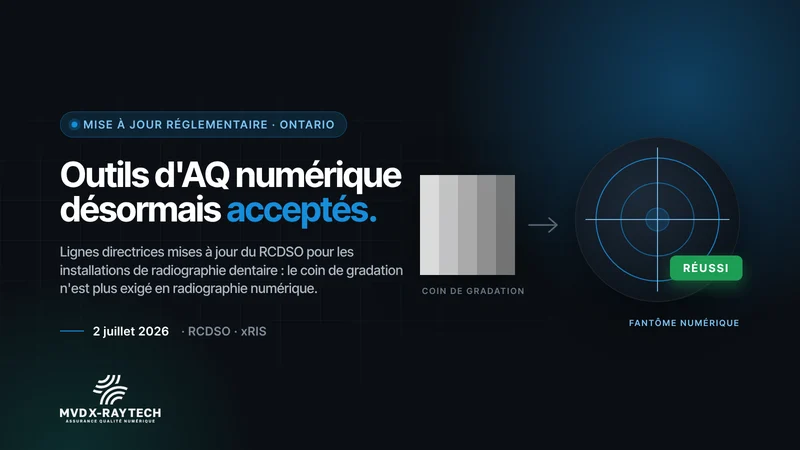
De nombreuses cliniques effectuent encore leur « AQ quotidienne » à l'aide d'un coin sensitométrique (step wedge), un outil conçu à l'origine pour la radiographie argentique des années 1950. Bien que les coins sensitométriques offrent une référence visuelle sommaire, ils ne peuvent pas évaluer avec précision le rendement d'un détecteur de radiographie numérique ni suivre les paramètres d'imagerie modernes.
Les systèmes de radiographie numérique exigent des tests quantitatifs, et non des approximations visuelles. Le problème ? La plupart des cliniques n'ont pas encore rattrapé la réalité de l'AQN - laissant plusieurs d'entre elles techniquement non conformes, même lorsqu'elles effectuent des tests quotidiens.
Le virage vers les dispositifs d'AQN
Pour véritablement respecter l'intention du Code de sécurité 30 (assurer la constance de l'image, la sécurité des patients et l'optimisation des radiations), les cliniques dentaires doivent utiliser des dispositifs d'AQN basés sur un fantôme plutôt que des outils visuels comme les coins sensitométriques.
Un dispositif fantôme est un objet de référence conçu pour tester la constance et la précision des systèmes de radiographie numérique. Ces motifs permettent au logiciel de mesurer automatiquement le contraste, la netteté, la densité et l'uniformité, produisant des données numériques objectives et retirant l'interprétation humaine du processus d'AQ.
C'est là qu'intervient MVD X-Ray Technologies.
Découvrez le Phantom XY - le premier et unique fantôme d'AQN
Le Phantom XY, pour les appareils intra-oraux et panoramiques, et le Phantom XY 3D, pour les appareils panoramiques, de MVD X-Ray Technologies sont le seul fantôme d'AQ entièrement numérique sur le marché conçu pour la conformité de la radiographie dentaire selon le Code de sécurité 30.
Chaque système est jumelé à un logiciel d'AQ intégré qui analyse automatiquement chaque partie de la chaîne d'imagerie - de l'acquisition et du traitement jusqu'au stockage, à la communication et à l'affichage. Cela permet aux cliniques de vérifier la qualité et la constance de l'image sur l'ensemble de leurs flux de travail numériques, et non seulement au moment de l'exposition.
Il est conçu pour effectuer des tests de constance quotidiens sur les appareils de radiographie intra-orale et panoramique, offrant aux cliniques :
- Une AQ quantitative automatisée (aucune estimation visuelle)
- Des résultats de réussite ou d'échec instantanés fondés sur des mesures numériques
- Un stockage infonuagique et une traçabilité pour tous les dossiers de tests
- Une analyse d'image assistée par IA, alignée sur les attentes de sécurité de Santé Canada
Avec Phantom XY, les cliniques peuvent démontrer leur conformité quotidienne, réduire le risque d'exposition aux radiations et conserver en tout temps une documentation d'AQ prête pour les audits.
Pourquoi cela compte maintenant
Le Code de sécurité 30 de Santé Canada établit les normes nationales de radioprotection et d'assurance qualité en radiographie dentaire. Bien que le code exige déjà des tests de constance quotidiens, de nombreuses cliniques s'appuient encore sur des outils datant de l'ère argentique qui ne reflètent pas les réalités de l'imagerie numérique moderne.
En passant à un flux de travail d'AQ numérique basé sur un fantôme, les cliniques peuvent s'assurer que leurs tests correspondent aux attentes actuelles du Code de sécurité 30, renforcer la sécurité des patients et démontrer un engagement proactif envers la conformité et la préparation aux inspections.