
Top 5 Mistakes Dental Clinics Make with X-Ray Quality Assurance


How to stay compliant under Safety Code 30
Many Canadian dental clinics have switched to digital X-ray systems but still follow old film era habits when it comes to Quality Assurance (QA). Health Canada’s Safety Code 30 (2022) lays out exactly how clinics must verify and document the performance of their imaging systems, including daily constancy tests and objective image quality evaluations on digital equipment (B.3.2, C.1.2.1, C.3.0 of the Code).
Below are the most common mistakes clinics make and what the Code actually expects instead.
1. Relying on Film Based Step Wedges for Digital X Rays
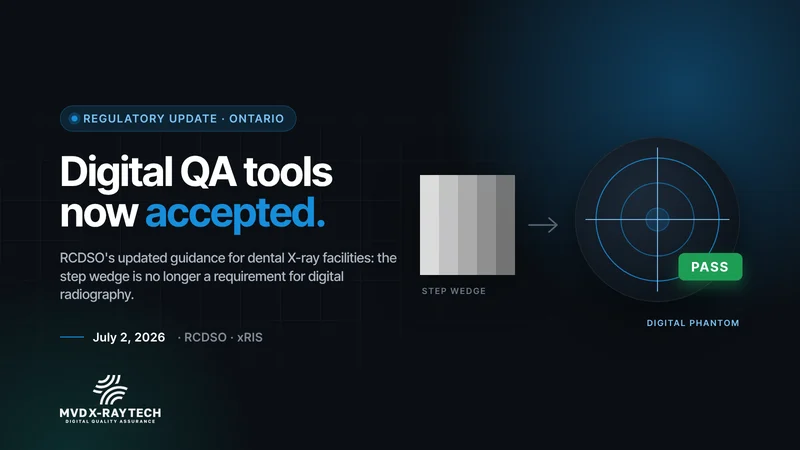
Safety Code 30 specifies that for digital radiography (DR) and computed radiography (CR) systems, QA must include testing of the image acquisition, storage, communication, and display systems. Step wedges were designed for film, not digital detectors. They depend on a human visually comparing shades of grey, a method that produces no quantitative data and cannot test communication or display performance.
Better approach: Use a digital phantom that measures density, contrast, resolution, and noise automatically, exactly the parameters referenced in Section M8 of the Code.
2. Skipping Daily Constancy Checks
Table 4 of Safety Code 30 lists phantoms as required equipment for daily quality control tests across CR and DR systems. Yet many clinics only test “when something looks off.” That violates Section C.1.2.1, which requires an ongoing QA schedule that includes baseline performance, reference images, and result evaluation procedures.
Better approach: Run a quick daily test image with a calibrated digital phantom. Phantom XY analyzes the file automatically and confirms whether exposure, contrast, and uniformity meet baseline values.
3. Not Recording and Evaluating Results
Safety Code 30 emphasizes record keeping and action levels for QA programs (C.1.2.1 #4). Some clinics still perform tests but keep no digital logs or reference images, making it impossible to prove compliance or identify performance drift over time.
Better approach: Use software that stores and trends QA data. Phantom XY’s cloud platform automatically archives each result with date and device metadata for full traceability during inspections.
4. Ignoring Display and Communication Systems
Section B.3.2 of Safety Code 30 makes clear that digital QA does not end at the sensor; it also covers the acquisition, storage, communication, and display systems.
Clinics often check their X-ray sensor but forget about monitor calibration or image transmission accuracy. A faded display can lead to incorrect clinical interpretation.
Better approach: Incorporate monitor checks and network verification into your QA routine as outlined in the Code, and use a phantom that quantifies uniformity and contrast so you can verify display fidelity.
5. Using Outdated Reference Images
The Code requires clinics to maintain a baseline performance image for each system (C.1.2.1 #2-3). If that reference is old or taken with different settings, new tests cannot accurately show changes in exposure or detector response.
Better approach: Re establish baselines after any equipment service, software update, or sensor replacement. Phantom XY automatically updates and tracks these baselines for consistent comparisons.
Conclusion
Under Safety Code 30, digital imaging QA is no longer a visual guess; it must be measurable, repeatable, and documented. Step wedges and manual logs belong to the film era. Digital tools like Phantom XY bring QA into the modern workflow with automated testing, AI based analysis, and cloud record keeping that fulfill the requirements of the current Safety Code 30 while simplifying compliance for your team.