
RCDSO Guidance Change: Digital QA Tools Now Accepted for Dental X-Ray Quality Control in Ontario

On July 2, 2026, the Royal College of Dental Surgeons of Ontario (RCDSO) updated its Information for Dental X-Ray Facilities, the article it prepares with the Ministry of Health's X-ray Inspection Service (xRIS) to explain what Ontario dental offices must have in place under the HARP Act and Regulation 543.
One change matters more than the rest for any clinic that has gone digital.
What Changed: The Step Wedge Is No Longer a Requirement
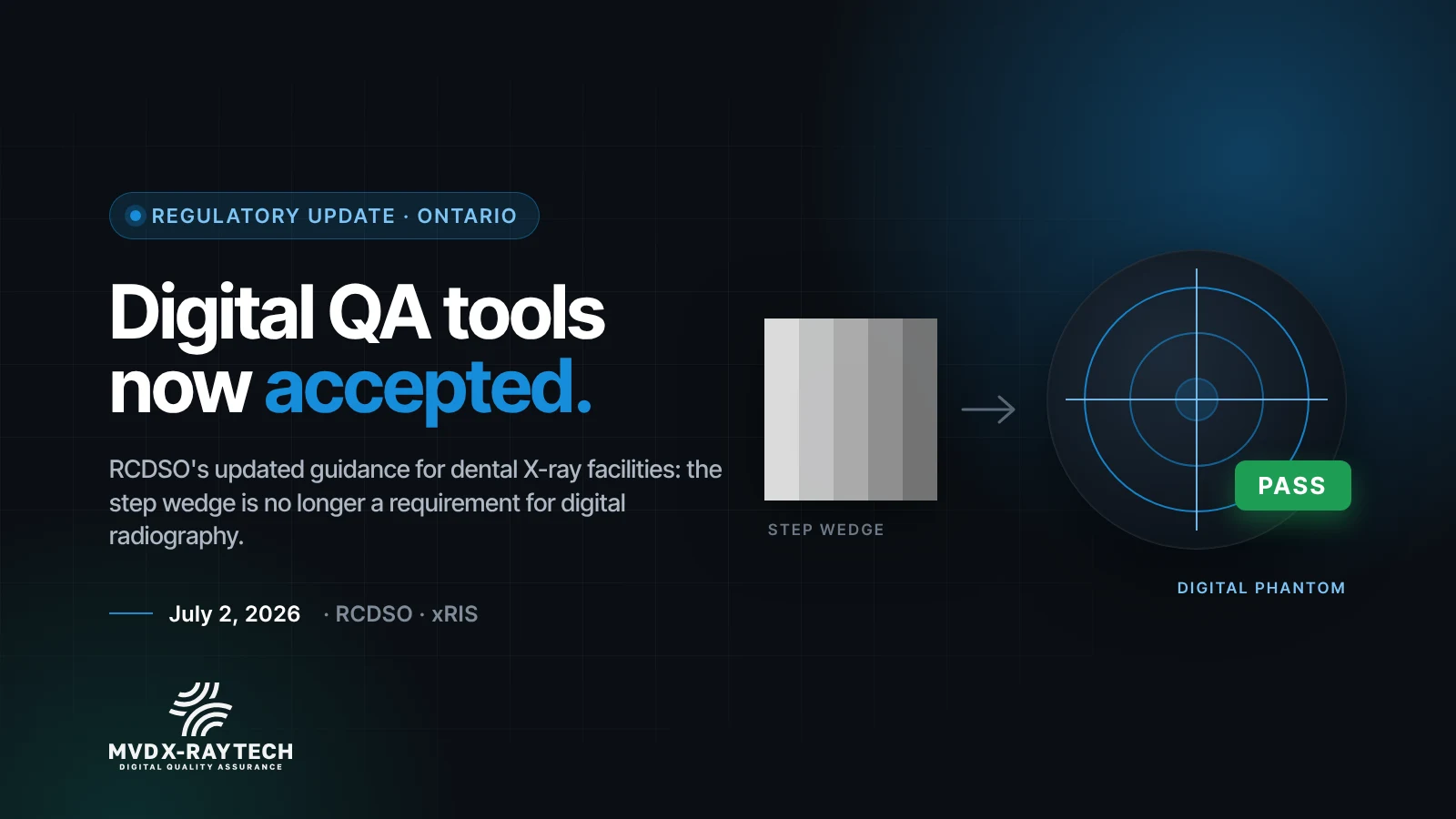
The previous version of the guidance described daily quality control in terms of the step wedge, the film-era test tool most Ontario clinics still keep in a drawer. The updated version now states that a step wedge is not a requirement for digital radiography, and that other appropriate digital quality assurance tools may be used.
In practical terms, RCDSO has recognized that digital sensors and panoramic systems need digital test methods. Clinics are free to run daily QC with a tool designed for digital imaging, and to keep the resulting records digitally.
Everything else below was already expected. This is the part that is new.
What Ontario Clinics Still Need Every Day
The updated guidance keeps the core daily duties for digital radiography in place:
- Daily quality control testing on each X-ray machine, on every day it is used. This applies to panoramic units as well as intraoral machines.
- A daily count of images exposed on each machine, recorded in a logbook.
- A daily retake record per machine, with the reason for each retake. The record should show whether the cause was operator error or an equipment or sensor problem, along with any corrective action taken.
- Six years of records, showing daily quality control on every day the equipment was used. Quality test results up to six years old should be available on site for an xRIS inspection.
RCDSO also advises that these records be transferred as part of the asset transfer when a practice is sold or merged.
What Stays With Your Radiation Protection Officer
Separate from daily QC, the guidance covers the duties of the radiation protection officer, who must be a dentist in a dental facility: acceptance testing of new and used equipment, annual quality tests covering patient entrance exposure, collimation and half-value layer, and testing after any alteration or servicing. Those tests are performed by a qualified tester and are not replaced by a daily QA device.
How Phantom XY and Phantom Cloud Line Up
The Phantom XY System was built as exactly the kind of digital QA tool the updated guidance describes, and Phantom Cloud handles the records that go with it:
- A two-minute daily QA test per device, for both panoramic and intraoral units, with objective results and a Q-Score.
- A digital X-ray logbook that records each exposure with date, time, X-ray type and operator, giving you the daily image count automatically.
- Retake entries with the reason and corrective action captured at the time of the retake.
- Results and logs stored for 10 years and exportable to PDF, well past the six-year requirement.
- Alerts for failed tests and missed tests, so a day without QC never slips by unnoticed.
For a broader look at how dental X-ray QA rules work and what a QA program should include, see our Digital Quality Assurance page.
Check Your Records Before Your Next Inspection
If your daily QC still depends on a step wedge, or any of the four daily items above is missing from your logbook, now is the time to close the gap. Book a demo and we will walk through your current QA routine against the updated RCDSO guidance.
This article summarizes publicly available RCDSO guidance for general information. It is not legal advice. Confirm current requirements with RCDSO and xRIS.