
How Often Should You Test Your Dental X-Ray Equipment?

Dental X-ray equipment does not stay perfectly calibrated forever. Small shifts happen, and testing is how you catch them.
But how often is "often enough"? The answer depends on the type of check, and the direction of Safety Code 30 is clear: more consistency, not less.
Here is a practical breakdown of how often dental clinics should be testing their X-ray equipment.
Daily Quality Assurance
The most important testing happens every day.
Daily quality assurance confirms that image quality is consistent and that nothing has drifted since the last patient.
Daily checks typically look at:
- Image clarity and contrast
- Consistency against a known reference
- Any new artifacts or irregularities
- Overall device performance
Skipping days is where most compliance gaps begin.
Periodic Checks
Some checks do not need to happen daily but still matter on a regular schedule.
These often include closer reviews of equipment condition, sensor performance, and accessories like positioning devices.
The goal is to spot wear before it affects diagnostics.
Annual and Professional Testing
On a longer cycle, equipment usually requires more formal inspection and servicing.
This can involve a qualified technician verifying output, calibration, and safety systems in line with provincial requirements and Safety Code 30.
Annual testing complements daily QA, it does not replace it.
Why Daily Testing Matters Most
Annual inspections are important, but problems rarely wait a year to appear.
Calibration drift, declining clarity, and small faults develop gradually. Daily QA is what catches them early, before they lead to retakes or failed inspections.
It is also what inspectors increasingly expect to see documented.
Making Daily Testing Sustainable
The challenge with daily QA is not difficulty. It is consistency.
Manual testing is easy to skip on a busy day. A structured, automated workflow makes it fast and reliable instead.
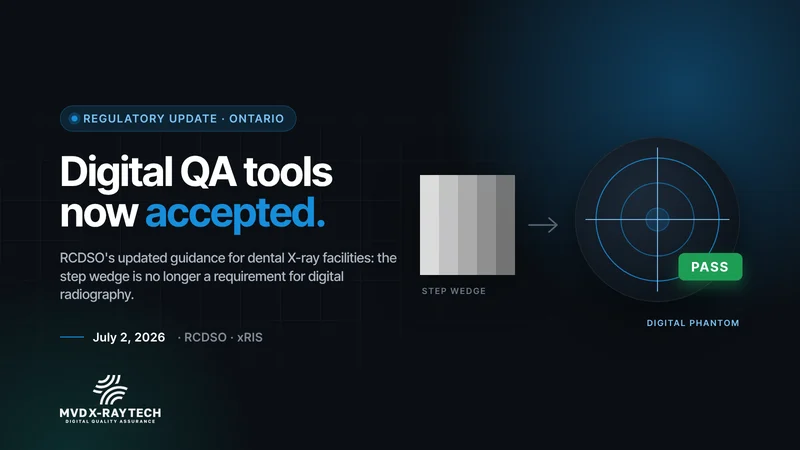
The Phantom XY System lets clinics complete daily QA in minutes and records every result automatically, so nothing gets missed.
Want to see how simple daily testing can be? Book a demo.