
AQ numérique et AQ manuelle : laquelle fait gagner du temps, améliore la précision et protège votre clinique


L'assurance qualité (AQ) des rayons X dentaires est exigée par le Code de sécurité 30 de Santé Canada, qui oblige les cliniques à vérifier régulièrement la qualité de l'image et le rendement de la radiation. Mais toutes les méthodes d'AQ ne se valent pas. De nombreuses cliniques s'appuient encore sur des outils manuels et des vérifications visuelles conçus à l'origine pour la radiographie argentique, tandis que d'autres ont adopté des systèmes d'AQ numérique qui automatisent les tests et la documentation.
Cet article présente les différences entre l'AQ manuelle et l'AQ numérique - comment chacune fonctionne, où elles montrent leurs limites, et pourquoi les méthodes numériques deviennent rapidement la nouvelle norme en matière de précision, de constance et de sécurité.
1. L'AQ manuelle : longue et inconstante
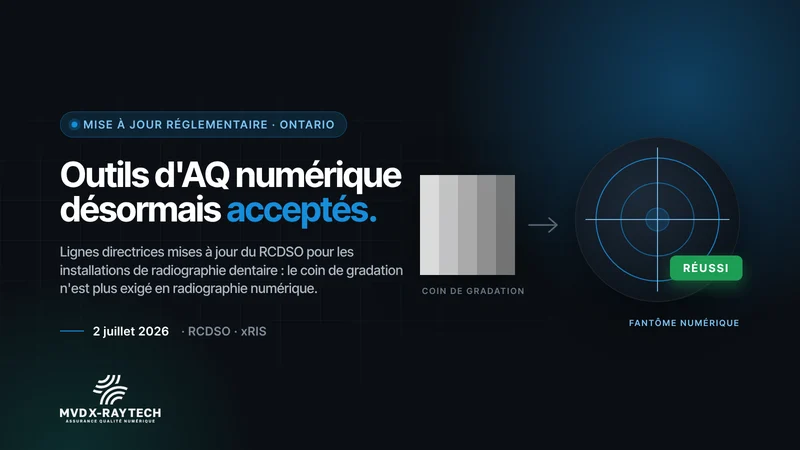
L'AQ manuelle traditionnelle consiste en une inspection visuelle à l'aide d'un coin sensitométrique ou d'un outil de contraste. Le personnel prend une exposition test et compare les teintes de gris à une image de référence.
Bien que simple, ce processus présente plusieurs inconvénients majeurs :
- Subjectivité : les résultats dépendent du jugement humain, des conditions d'éclairage et de la qualité du moniteur.
- Absence de traçabilité : la plupart des cliniques consignent les résultats manuellement, ou pas du tout, ce qui complique les audits.
- Mesures limitées : les vérifications visuelles ne peuvent pas mesurer des paramètres clés comme la résolution spatiale, le niveau de bruit ou la constance de la valeur des pixels.
- Perte de temps : chaque test doit être effectué, évalué et consigné à la main - ce qui prend souvent de 10 à 15 minutes par appareil et par jour.
En somme, l'AQ manuelle peut satisfaire une « tentative » de conformité, mais elle fournit rarement la preuve quantitative que le Code de sécurité 30 attend des systèmes numériques modernes.
2. L'AQ numérique : automatisée, quantitative et traçable
Les systèmes d'AQ numérique, comme Phantom XY de MVD X-Ray Technologies, automatisent ce que les coins sensitométriques ne peuvent pas faire. Le processus est simple :
- Capturez une image de test quotidienne du Phantom XY à l'aide de votre appareil de radiographie intra-orale ou panoramique.
- Téléversez-la dans le logiciel ou le portail infonuagique.
- Recevez instantanément des mesures numériques - contraste, densité, uniformité, résolution et bruit - comparées à votre valeur de référence.
Cette approche élimine la subjectivité et la consignation manuelle. Chaque résultat de test est stocké automatiquement, horodaté et accessible pour les audits ou les révisions de service.
Avantages :
- Efficacité : AQ quotidienne en environ deux minutes par appareil.
- Données objectives : analyse quantitative, et non estimation visuelle.
- Détection des écarts : repère même les dérives de rendement subtiles avant qu'elles n'affectent la qualité diagnostique.
- Conservation des dossiers : l'archivage infonuagique assure une traçabilité à long terme pour les inspections réglementaires.
3. Impact sur la sécurité : protéger les patients et le personnel
Une AQ précise a une incidence directe sur la radioprotection. Une mauvaise calibration ou une dégradation d'image non détectée peut entraîner des reprises inutiles, doublant l'exposition aux radiations pour les patients comme pour le personnel. Les systèmes d'AQ numérique détectent tôt ces petites incohérences, ce qui permet aux cliniques de corriger les problèmes avant que la qualité d'image en souffre ou que des reprises soient nécessaires. En maintenant un rendement d'exposition et une qualité d'image constants, les cliniques demeurent non seulement conformes, mais démontrent aussi un engagement mesurable envers la protection des patients.
4. En résumé
L'AQ manuelle était acceptable à l'ère de la pellicule, mais elle ne répond plus aux besoins de la radiographie numérique moderne. L'AQ numérique offre des résultats mesurables, des flux de travail plus rapides et une traçabilité complète, alignés sur les attentes du Code de sécurité 30.
Les cliniques qui utilisent des solutions automatisées comme Phantom XY peuvent assurer une qualité d'image constante, réduire l'exposition aux radiations et faire économiser un temps précieux au personnel chaque jour.