
Ce que signifie le Code de sécurité 30 pour votre clinique dentaire

Un guide clair pour l'assurance qualité numérique quotidienne des rayons X
En matière de radiographie dentaire, la qualité de l'image et la radioprotection sont directement liées. Le Code de sécurité 30 (2022) de Santé Canada établit les normes nationales régissant l'exploitation et l'entretien des systèmes radiographiques des cliniques dentaires, y compris la responsabilité de vérifier la qualité de l'image chaque jour.
La plupart des cliniques connaissent le Code de sécurité 30 en théorie, mais les détails leur échappent souvent. Voici ce que le code actuel de 2022 exige réellement, et pourquoi les vieux outils de « l'ère argentique », comme les coins sensitométriques, ne suffisent plus.
Ce qu'exige le Code de sécurité 30 de 2022
En vertu de la section B.3 du Code de sécurité 30 de 2022, chaque établissement dentaire doit effectuer :
- Des tests de constance (quotidiens) sur toutes les unités intraorales, panoramiques et de tomographie volumique à faisceau conique (TVFC), afin de s'assurer que le système d'imagerie est stable.
- Des vérifications de routine de la qualité de l'image évaluant la densité, le contraste, la résolution spatiale et la constance du bruit.
- La documentation de chaque test, afin que les résultats puissent être présentés lors d'audits ou d'inspections.
Ces exigences sont claires : les cliniques doivent démontrer, à l'aide de dossiers, que leurs systèmes d'imagerie produisent des images constantes et diagnostiquement acceptables - chaque jour.
Pourquoi les coins sensitométriques ne respectent pas la norme de 2022
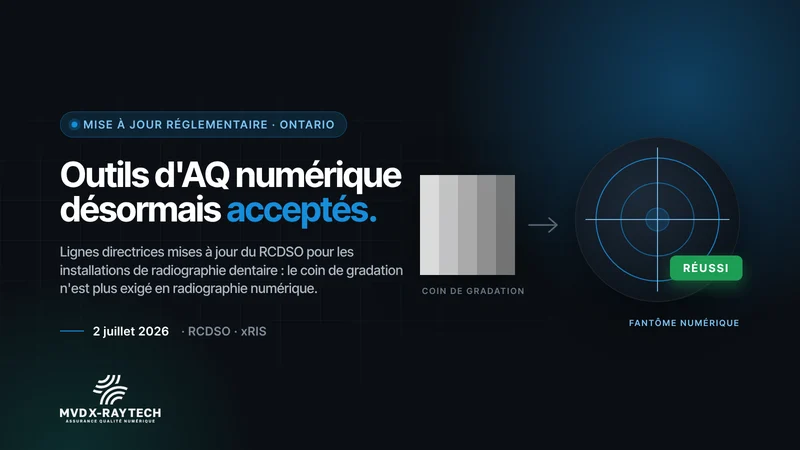
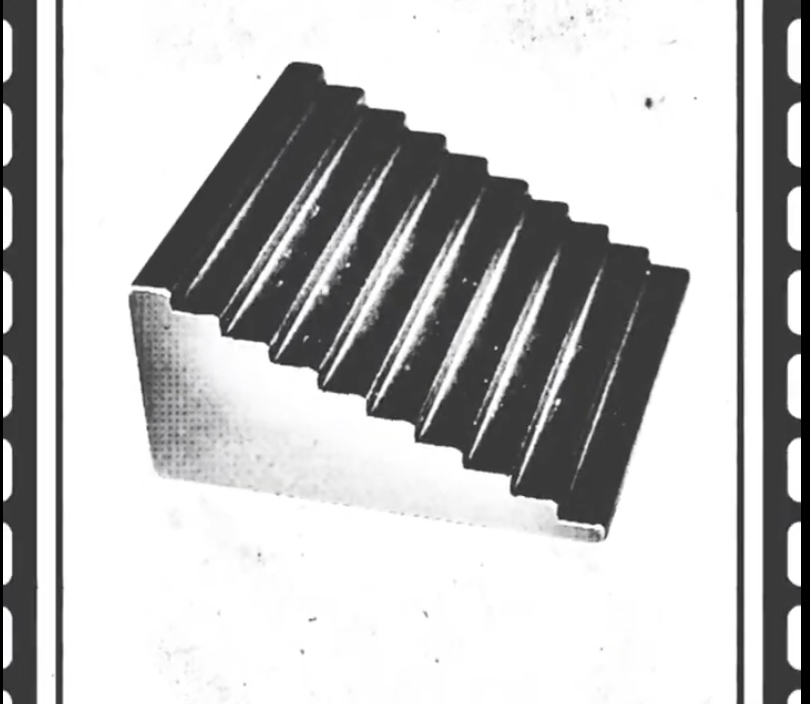
Les coins sensitométriques ont été créés pour la radiographie argentique dans les années 1950. Ils reposent sur une comparaison visuelle : une personne examine des teintes de gris et juge si l'image « semble correcte ».
Cette approche ne tient plus la route sous le Code de sécurité 30 de 2022, parce que :
- Elle est subjective - des membres du personnel différents peuvent porter des jugements différents.
- Elle manque de données quantitatives (aucune valeur mesurable à consigner ou à suivre dans le temps).
- Elle ne s'intègre pas aux systèmes numériques pour l'archivage ou la traçabilité des images.
Autrement dit, les coins sensitométriques ne peuvent pas produire le type de mesures objectives et reproductibles que le code de 2022 attend de l'AQN.
Comment Phantom XY répond au Code de sécurité 30, de façon numérique
C'est là qu'intervient Phantom XY de MVD X-Ray Technologies - le premier fantôme d'AQ entièrement numérique conçu spécifiquement pour la conformité de la radiographie dentaire selon le Code de sécurité 30.
Phantom XY, pour les appareils intra-oraux et panoramiques, automatise ce que le coin sensitométrique tentait de faire manuellement :
- Effectue des tests de constance quotidiens alignés sur les exigences du Code de sécurité 30 de 2022.
- Analyse les images de façon quantitative (à l'aide de mesures comme le contraste, la densité, la résolution et le bruit), sans estimation subjective.
- Génère des résultats de réussite ou d'échec instantanés fondés sur des mesures numériques.
- Stocke les résultats dans le nuage pour la traçabilité et les audits.
- Utilise des algorithmes fondés sur l'IA pour s'assurer que chaque image répond aux attentes diagnostiques.
Avec Phantom XY, les cliniques peuvent démontrer une conformité complète aux exigences actuelles de 2022 du Code de sécurité 30, sans suivi manuel ni interprétation subjective.
En résumé
Le Code de sécurité 30 (2022) exige déjà que les cliniques dentaires effectuent et documentent des tests d'AQ quotidiens pour tout l'équipement de radiographie numérique.
S'appuyer sur des coins sensitométriques ou des vérifications visuelles expose les cliniques à des risques. Ces méthodes ne peuvent pas produire les dossiers quantitatifs exigés par le code.
En passant à Phantom XY, les cliniques peuvent moderniser leur flux de travail d'AQ, respecter le code en toute confiance et garantir une qualité d'image diagnostique constante et sécuritaire, chaque jour.